Microfluidizer Technology Explained: How Modern Skincare Delivery Systems Work
Learn what microfluidizer technology is, how high-pressure processing creates ultra-fine skincare emulsions, and why modern formulations use it for smoother texture and stability.

As skincare formulations become increasingly sophisticated, delivery technology has become just as important as ingredient selection.
One technology that frequently appears in modern cosmetic formulation discussions is microfluidizer processing, a high-pressure system designed to create extremely fine and uniform particles within skincare formulations.
This article explains what microfluidizer technology is, how it works, and why some skincare brands reference it when discussing absorption and formulation stability.
What Is Microfluidizer Technology?
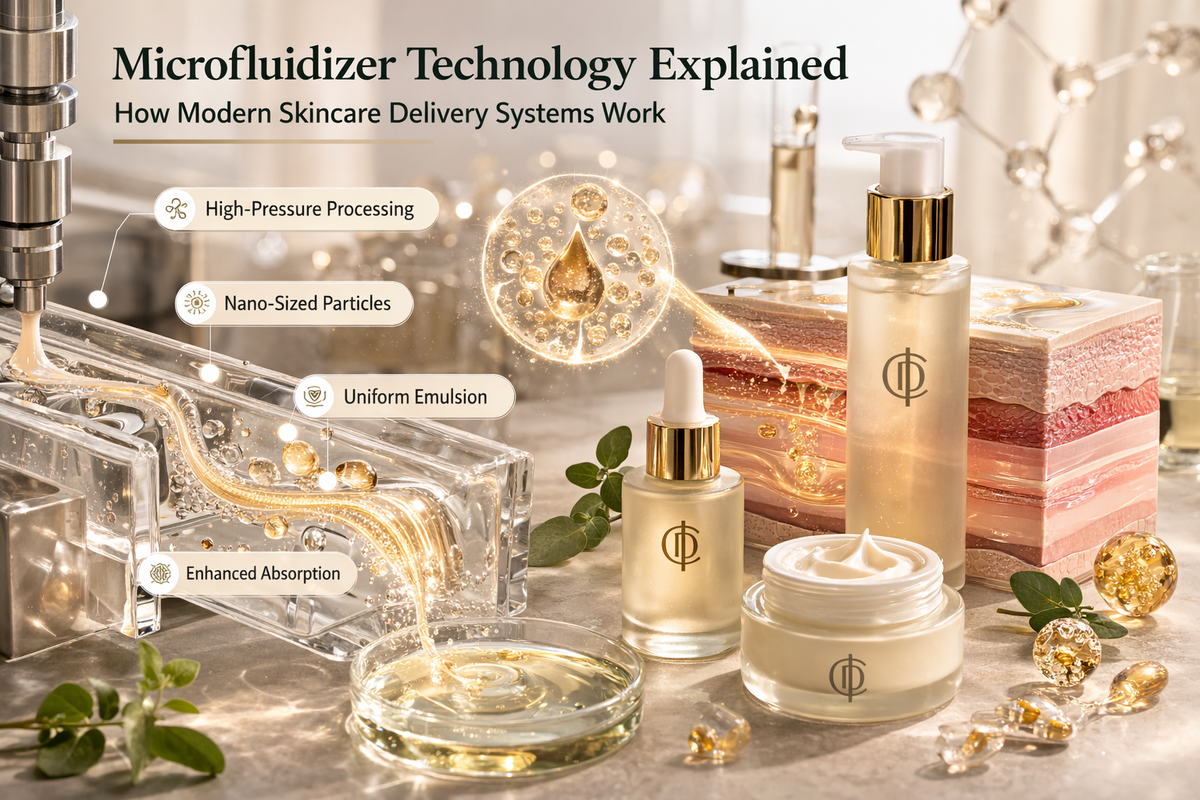
Microfluidizer technology is a high-pressure processing method used to reduce particle size and create highly uniform emulsions.
In this process, a liquid formulation is forced through specially engineered micro-channels at extremely high pressure. The intense shear forces and turbulence break down droplets into very small particles and distribute them evenly throughout the formulation.
This results in:
- smaller particle size
- more uniform dispersion
- improved formulation stability
Microfluidization is widely used in pharmaceutical, biotechnology, food, and cosmetic industries where precise particle control is important.
Why Particle Size Matters in Skincare
In skincare formulations, many active ingredients are delivered through emulsions or liposome systems.
If particles are large or unevenly distributed, the formulation may:
- separate over time
- feel heavy on the skin
- absorb unevenly
Microfluidizer processing helps reduce particles to micro or nano scale, allowing ingredients to disperse more evenly within the formula.
In some cases, microfluidization is used to create nano-sized liposomes, which can act as delivery vehicles that carry ingredients within the formulation.
This can contribute to:
- smoother texture
- improved stability
- more consistent application on the skin
How Microfluidizer Processing Works
The technology typically follows a high-pressure multi-step process.
Step 1 — High-Pressure Pumping
The formulation is pumped into the system at extremely high pressure.
Step 2 — Micro-Channel Processing
The liquid passes through precisely engineered micro-channels, where it experiences intense shear forces and turbulence.
These forces break down droplets and particles into smaller sizes while mixing them evenly.
Step 3 — Uniform Nano or Micro Emulsion Formation
The result is a formulation with a tight particle size distribution, meaning particles are consistently similar in size.
This uniformity can help improve both product stability and texture.
Microfluidizer Technology in Cosmetic Formulation
In the cosmetics industry, microfluidizer systems are often used to create stable nanoemulsions and liposomal formulations.
Compared with traditional mixing methods, microfluidization allows:
- more precise particle size control
- improved consistency between batches
- smoother product texture
- enhanced long-term stability
For creams, serums, and lotions, this can contribute to a lighter feel while maintaining hydration support.
Many cosmetic manufacturers also use microfluidizer technology to produce nanoemulsions, which can improve the dispersion of active ingredients in a formula.
Microfluidizer Technology in RADIANSOME™ Formulations
Some skincare brands reference microfluidizer technology when describing how their formulations are produced.
In the case of RADIANSOME™ 100, the formulas are described as undergoing microfluidization to create ultra-fine particles within the skincare system.
The intended formulation goals typically include:
- smoother ingredient dispersion
- improved hydration layering
- lightweight texture with even absorption
Because the system is structured as Toner → Essence → Cream, each layer builds on the previous step to support hydration and elasticity-focused routines.
Rather than relying on a single product, the system emphasizes layered delivery of ingredients through a structured routine.
Microfluidizer vs Traditional Emulsion Processing
Traditional cosmetic emulsions are often created using standard mixing or homogenization techniques.
While these methods can produce effective products, they may create particles with broader size distributions, meaning droplet sizes vary more widely.
Microfluidizer processing differs by producing much tighter particle size distribution, which can improve both stability and product feel.
This level of precision is one reason microfluidization is widely used in industries that require consistent formulation performance.
Why Delivery Technology Is Becoming More Important
Modern skincare increasingly combines ingredient science with formulation engineering.
Even when two products contain similar ingredients, differences in formulation structure can influence:
- how a product spreads
- how evenly ingredients distribute
- how stable the formula remains over time
As a result, technologies such as liposome delivery, nanoemulsions, and microfluidization are becoming more frequently referenced in cosmetic research and marketing discussions.
Conclusion
Microfluidizer technology is a high-pressure formulation method used to create extremely fine and uniform particles within skincare products.
By producing more stable emulsions and smaller particle sizes, the technology can contribute to smoother texture, consistent ingredient dispersion, and improved formulation stability.
In modern skincare systems such as RADIANSOME™ 100, microfluidizer processing is often referenced as part of a broader approach that combines ingredient selection, delivery systems, and layered skincare routines.
For readers exploring how formulation technology influences skincare performance, microfluidization offers a useful example of how cosmetic science continues to evolve beyond ingredient trends alone.
Related Guides
To explore related skincare concepts, see:
👉 RADIANSOME™ 100: Structural Overview of the Elastic Radiance System
👉 Giant BYoungPool™: Understanding RIMAN’s Exclusive Centella Variety
👉 Jeju Lava Energy Water Explained